

Sciatica affects millions of people worldwide, causing sharp, radiating pain that travels from the lower back down through the legs. This debilitating condition can make simple daily activities feel impossible, leaving many searching for effective, natural relief methods (Ropper & Zafonte, 2015).
The good news? Yoga offers a gentle yet powerful approach to managing sciatica and lower limb pain. Through targeted poses, mindful breathing, and gentle stretching, yoga can help reduce inflammation, improve flexibility, and strengthen the muscles that support your spine and pelvis (Cramer et al., 2013).
This comprehensive guide will walk you through the most effective yoga poses for sciatica relief, along with essential precautions to ensure your practice remains safe and beneficial. Whether you’re dealing with acute pain or chronic discomfort, these evidence-based techniques can become valuable tools in your healing journey.
Understanding Sciatica and Lower Limb Pain
Sciatica occurs when the sciatic nerve—the longest nerve in your body—becomes compressed or irritated. This nerve runs from your lower back, through your hips and buttocks, and down each leg. When compressed, it can cause pain, numbness, tingling, or weakness anywhere along this pathway (Stafford et al., 2007).
Common causes of sciatica include herniated discs, spinal stenosis, piriformis syndrome, and muscle tension in the lower back and hips (Ropper & Zafonte, 2015). The pain can range from a mild ache to a sharp, burning sensation that makes sitting, standing, or walking extremely uncomfortable.
Lower limb pain often accompanies sciatica but can also result from other factors such as muscle imbalances, poor posture, or prolonged sitting. Understanding the root cause of your pain is crucial for developing an effective treatment approach (Airaksinen et al., 2006).
The Therapeutic Benefits of Yoga for Sciatica
Yoga addresses sciatica through multiple mechanisms. First, gentle stretching helps release tension in the muscles surrounding the sciatic nerve, particularly in the piriformis, hip flexors, and lower back muscles. Second, yoga strengthens the core and back muscles that support proper spinal alignment (Iyengar, 2005).
Regular yoga practice also promotes better circulation, which can reduce inflammation around compressed nerves. The mindful breathing techniques incorporated in yoga help activate the parasympathetic nervous system, promoting relaxation and natural pain relief (Lasater, 1995).
Research supports yoga’s effectiveness for back pain and sciatica. A study published in the Annals of Internal Medicine found that yoga was as effective as physical therapy for treating chronic lower back pain (Saper et al., 2017). The gentle, controlled movements help improve flexibility while building strength in key support muscles.
Essential Yoga Poses for Sciatica Relief
Child’s Pose (Balasana)
Child’s Pose serves as both a therapeutic posture and a resting position throughout your practice. This gentle forward fold helps elongate the spine and release tension in the lower back muscles (McCall, 2007).
Begin on your hands and knees, then sit back on your heels while extending your arms forward on the mat. Rest your forehead on the ground and breathe deeply. Hold for 1-3 minutes, focusing on releasing tension with each exhale.
This pose is particularly beneficial for those with acute sciatica pain, as it provides gentle traction for the spine without placing weight on the affected areas.
Downward-Facing Dog
Downward-Facing Dog creates length in the spine while gently stretching the hamstrings and calves—areas that often contribute to sciatic pain when tight (Iyengar, 2005).
Start on hands and knees, tuck your toes under, and lift your hips up and back. Keep a slight bend in your knees if needed, and focus on lengthening your spine rather than straightening your legs completely. Hold for 30 seconds to 1 minute.
If this pose feels too intense, try the modification using blocks under your hands or practice against a wall.
Dragon Pose (Yin Yoga)
Dragon Pose provides a deep hip flexor stretch while gently opening the lower back. This yin yoga posture allows for passive stretching, making it ideal for addressing tight hip flexors that can contribute to sciatica (Clark, 2011).
From a low lunge position, lower your back knee to the ground and slide it back slightly. Rest your hands on blocks or the floor inside your front foot. Hold for 3-5 minutes on each side, breathing deeply and allowing gravity to deepen the stretch gradually.
Half Moon Pose (Ardha Chandrasana)
Half Moon Pose strengthens the standing leg while stretching the spine and improving balance. This pose can help address muscle imbalances that contribute to sciatic pain (Lasater, 1995).
From Triangle Pose, shift weight to your front foot and lift your back leg parallel to the floor. Place your bottom hand on a block or the floor and extend your top arm toward the ceiling. Focus on creating length through your spine and engaged core muscles.
Fish Pose (Matsyasana)
Fish Pose provides a gentle backbend that can help counteract the forward posture that often contributes to sciatica. This pose opens the chest and gently extends the spine (Iyengar, 2005).
Lie on your back with your legs extended. Slide your hands under your lower back, then press your forearms into the ground to lift your chest and the crown of your head. Breathe deeply and hold for 30 seconds to 1 minute.
Cobra Pose (Bhujangasana)
Cobra Pose strengthens the back muscles while creating gentle spinal extension. This active backbend helps improve posture and can reduce pressure on spinal discs (McCall, 2007).
Lie face down with your palms under your shoulders. Press into your hands to lift your chest, keeping your pelvis grounded. Focus on using your back muscles rather than pushing with your arms. Hold for 15-30 seconds.
Sphinx Pose (Salamba Bhujangasana, Yin Variation)
Sphinx Pose offers a gentler alternative to Cobra, providing passive spinal extension that can help relieve disc compression (Clark, 2011).
Lie on your belly with your forearms on the ground, elbows under your shoulders. Allow your lower back to gently arch while keeping your legs relaxed. Hold for 3-5 minutes, focusing on deep breathing.
Shoelace Pose (Yin Yoga)
Shoelace Pose provides a deep stretch for the outer hips and IT band, areas that can contribute to sciatic pain when tight (Clark, 2011).
Sit with your right shin in front of your left, stacking your knees if possible. Fold forward gently, resting on your forearms or a bolster. Hold for 3-5 minutes on each side.
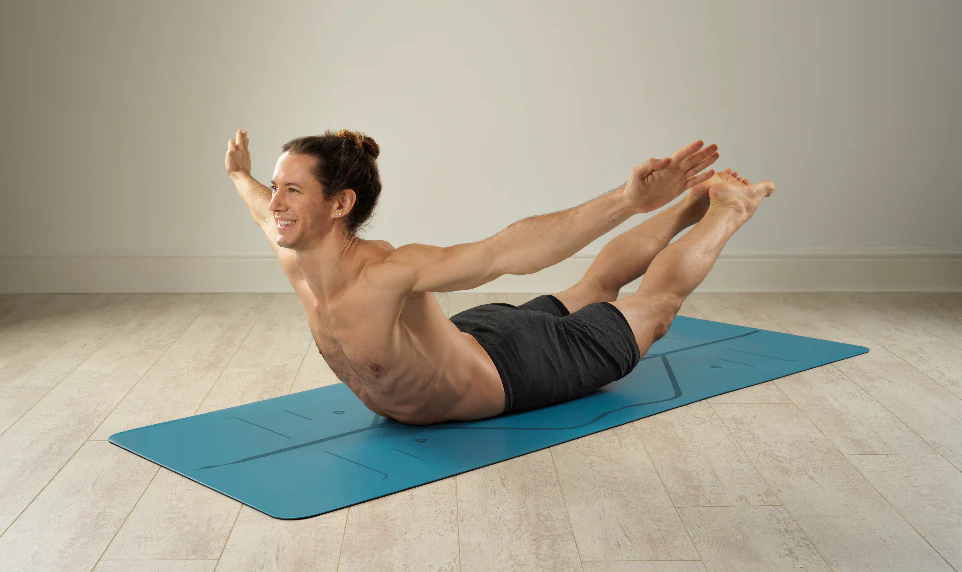
Locust Pose (Salabhasana)
Locust Pose strengthens the entire back body, including the glutes and hamstrings, which are crucial for supporting the lower back and preventing sciatica (Iyengar, 2005).
Lie face down with your arms at your sides. Lift your chest, arms, and legs simultaneously, creating a gentle backbend. Hold for 15-30 seconds, building strength gradually.
Knees-to-Chest Pose (Pawanmuktasana)
This gentle pose helps release tension in the lower back while providing a soothing stretch for the hip flexors (McCall, 2007).
Lie on your back and draw both knees toward your chest. Hold your shins and gently rock side to side. This pose can provide immediate relief for acute sciatic pain.
Reclined Pigeon Pose (Supta Kapotasana)
Reclined Pigeon targets the piriformis muscle, which can compress the sciatic nerve when tight. This supine variation is safer than traditional pigeon pose for those with sciatica (Cramer et al., 2013).
Lie on your back and cross your right ankle over your left thigh. Thread your hands behind your left thigh and gently draw your legs toward your chest. Hold for 1-2 minutes on each side.
Bridge Pose (Setu Bandha Sarvangasana)
Bridge Pose strengthens the glutes and hamstrings while gently opening the hip flexors. Strong glutes are essential for maintaining proper pelvic alignment and reducing sciatic pain (Lasater, 1995).
Lie on your back with knees bent and feet hip-width apart. Press through your heels to lift your hips, creating a straight line from knees to shoulders. Hold for 30 seconds to 1 minute.
Shoulderstand (Sarvangasana)
Shoulderstand can help relieve pressure on the lower back by reversing gravity’s effects. However, this pose should be avoided during acute sciatica episodes (Iyengar, 2005).
Use props like blankets under your shoulders and practice against a wall for support. Hold only as long as comfortable, typically 30 seconds to 2 minutes.
Half Lord of the Fishes Pose (Ardha Matsyendrasana)
This seated twist helps improve spinal mobility while stretching the hip rotators that can contribute to sciatic compression (McCall, 2007).
Sit with your right leg extended and cross your left foot over your right thigh. Place your right elbow against your left knee and twist gently to the left. Hold for 30 seconds to 1 minute on each side.
Eye of the Needle Pose (Yin Yoga)
Eye of the Needle provides a gentle hip opener that targets the deep hip rotators without requiring extreme flexibility (Clark, 2011).
Lie on your back and cross your right ankle over your left thigh. Keep your left foot on the ground and breathe deeply, allowing gravity to create the stretch. Hold for 3-5 minutes on each side.
Legs-Up-the-Wall Pose (Viparita Karani)
This restorative inversion helps reduce swelling in the legs while promoting relaxation and pain relief (Woodyard, 2011).
Lie on your back with your legs extended up a wall. Rest your arms at your sides and focus on deep, calming breaths. Hold for 5-15 minutes.
Precautions and Modifications
Safety should always be your top priority when practicing yoga for sciatica. Never force poses or ignore pain signals from your body. Sharp, shooting pain indicates you should back out of a pose immediately (McCall, 2007).
Avoid deep forward folds during acute sciatica episodes, as these can increase disc pressure (Ropper & Zafonte, 2015). Similarly, avoid poses that require extreme spinal flexion or rotation when experiencing severe symptoms.
Use props liberally to make poses accessible. Blocks, bolsters, blankets, and straps can help you maintain proper alignment while accommodating your current limitations (Lasater, 1995).
Consider working with a qualified yoga instructor who has experience with therapeutic applications. They can provide personalized modifications and ensure you’re practicing safely (Cramer et al., 2013).
Listen to your body’s feedback and modify poses as needed. Some days you may need gentler variations, while other days you might feel capable of deeper stretches.
Additional Tips for Success
Consistency matters more than intensity when using yoga for sciatica relief. A gentle 15-20 minute daily practice is more beneficial than an intense weekly session (Woodyard, 2011).
Combine your yoga practice with other healthy habits like regular walking, proper ergonomics, and stress management techniques (Airaksinen et al., 2006). Sciatica often involves multiple contributing factors, so a comprehensive approach yields the best results.
Consider incorporating heat therapy before practice and ice after if inflammation is present. Always consult with healthcare providers about combining yoga with other treatments (Stafford et al., 2007).
Keep a practice journal to track which poses feel most beneficial and note any patterns in your pain levels. This information can help you customize your routine for maximum effectiveness (Cramer et al., 2013).
Embracing Yoga as Your Path to Pain Relief
Yoga offers a gentle, accessible approach to managing sciatica and lower limb pain. Through consistent practice of these targeted poses, combined with proper precautions and modifications, you can experience significant improvements in pain levels, mobility, and overall quality of life (Saper et al., 2017; Cramer et al., 2013).
Remember that healing takes time, and progress may come in small increments. Be patient with yourself and celebrate each milestone along your journey. With dedication to your practice and attention to your body’s needs, yoga can become a powerful ally in your recovery from sciatica (Woodyard, 2011).
Start slowly, listen to your body, and don’t hesitate to seek guidance from qualified instructors or healthcare providers. Your path to pain relief through yoga begins with a single breath and a willingness to move mindfully toward healing.
References
Woodyard, C. (2011). Exploring the therapeutic effects of yoga and its ability to increase quality of life. International Journal of Yoga, 4(2), 49–54. https://doi.org/10.4103/0973-6131.85485
Airaksinen, O., Brox, J. I., Cedraschi, C., Hildebrandt, J., Klaber-Moffett, J., Kovacs, F., … Zanoli, G. (2006). Chapter 4. European guidelines for the management of chronic nonspecific low back pain. European Spine Journal, 15(Suppl 2), S192–S300. https://doi.org/10.1007/s00586-006-1072-1
Clark, S. (2011). The Complete Guide to Yin Yoga: The Philosophy and Practice of Yin Yoga. White Cloud Press.
Cramer, H., Lauche, R., Haller, H., Dobos, G., & Michalsen, A. (2013). A systematic review and meta-analysis of yoga for low back pain. The Clinical Journal of Pain, 29(5), 450–460. https://doi.org/10.1097/AJP.0b013e31825e1492
Iyengar, B. K. S. (2005). Light on Yoga. HarperCollins.
Lasater, J. H. (1995). Relax and Renew: Restful Yoga for Stressful Times. Rodmell Press.
McCall, T. (2007). Yoga as Medicine: The Yogic Prescription for Health and Healing. Bantam.
Ropper, A. H., & Zafonte, R. D. (2015). Sciatica. New England Journal of Medicine, 372(13), 1240–1248. https://doi.org/10.1056/NEJMra1410151
Saper, R. B., Lemaster, C., Delitto, A., Sherman, K. J., Herman, P. M., Sadikova, E., … Weinberg, J. (2017). Yoga, physical therapy, or education for chronic low back pain: A randomized noninferiority trial. Annals of Internal Medicine, 167(2), 85–94. https://doi.org/10.7326/M16-2579
Stafford, M. A., Peng, P., & Hill, D. A. (2007). Sciatica: A review of history, epidemiology, pathogenesis, and the role of epidural steroid injection in management. British Journal of Anaesthesia, 99(4), 461–473. https://doi.org/10.1093/bja/aem238


Hi, this is a comment.
To get started with moderating, editing, and deleting comments, please visit the Comments screen in the dashboard.
Commenter avatars come from Gravatar.